

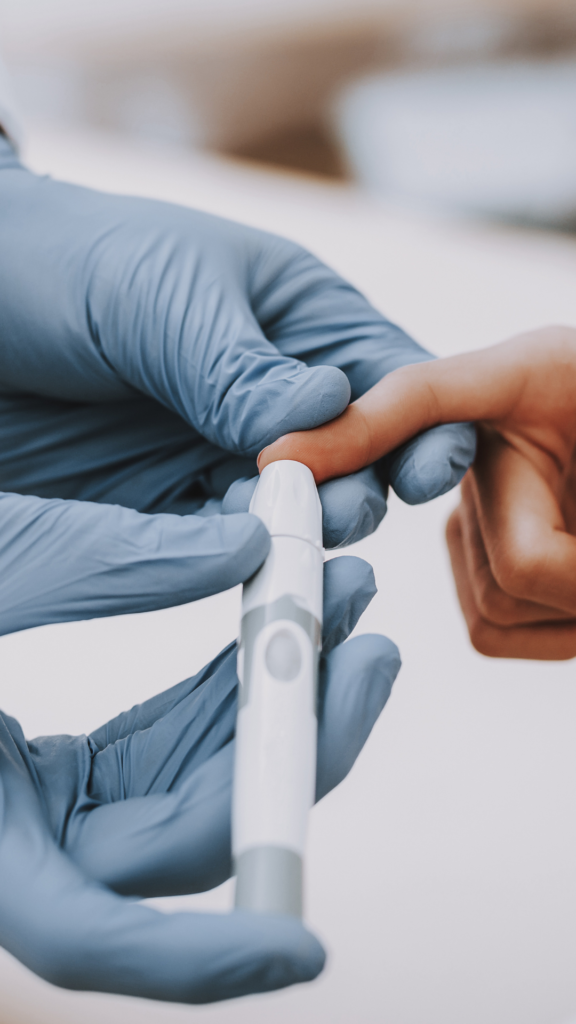
Many people with diabetes wonder how to lower A1C naturally, but it’s important to know what actually helps and what is mostly noise.
As with any health topic, there are a lot of ideas floating around out there about how to lower A1C naturally. In this article, we’ll go over what A1C is, what it means, 7 proven ways that may help lower A1C naturally, and 5 common myths to ignore.
***This article is not intended to provide medical advice, diagnosis, opinion, treatment or services. This article and the links contained in it provide general information for educational purposes only. The information provided in this article is not a substitute for medical care, and should not be used in place of the advice of your physician or registered dietitian.***
What is A1C?
Before we dive into how to lower A1C naturally, let’s briefly review what A1C is.
A1C is short for hemoglobin A1C. It is a blood test used to diagnose prediabetes, type 1 diabetes, and type 2 diabetes. And if you already know you have diabetes, the A1C is used as one way to measure blood sugar control over time.
The A1C reflects what your average blood sugar has been over the last 2 to 3 months and tells your doctor how much glucose is attached to your red blood cells. A higher A1C means that, on average, blood sugar has been running higher.
What does A1C stand for?
As I mentioned above, A1C is a short name for a blood test called glycated hemoglobin.
- Hemoglobin is a protein in red blood cells that carries oxygen through the body.
- A1C is the form of hemoglobin measured in this test because it shows how much glucose is attached to it over time. Mayo Clinic describes the test as measuring the percentage of hemoglobin coated with sugar.
A1C is important, but it is not the whole story
A1C is useful, but it does not show the full picture. The American Diabetes Association notes that A1C reflects average glucose over time, but it does not show daily highs and lows. That means two people can have the same A1C and very different blood sugar patterns. Mayo Clinic also notes that certain conditions, such as pregnancy or some hemoglobin differences, can make the test less accurate.
So yes, A1C matters. But it is not the only thing that matters.
Easy A1C chart
Use the A1C chart below to estimate what an A1C level may mean for average blood sugar.
| A1C value | Estimated average blood glucose level |
|---|---|
| 5% | 98 mg/dL |
| 6% | 126 mg/dL |
| 7% | 154 mg/dL |
| 8% | 183 mg/dL |
| 9% | 212 mg/dL |
| 10% | 240 mg/dL |
| 11% | 269 mg/dL |
| 12% | 298 mg/dL |
For many people with diabetes, a common A1C goal is below 7%, but NIDDK notes that goals should be individualized.
How to lower A1C naturally

Now let’s get into why you’re really here. If you’re searching for how to lower A1C naturally, these are the habits that tend to matter most over time.
1. Be more physically active

This does not mean destroying yourself at the gym every day or forcing yourself to do a workout you hate. Even something as simple as walking may help lower blood sugar levels.
ADA says physical activity can lower blood glucose in the short term and, when done regularly, can also lower A1C. CDC also calls physical activity a foundation of diabetes management.
2. Prioritize overnight blood sugar levels
Sleep makes up a big chunk of the day. If blood sugar runs high overnight, that can affect your averages more than people realize.
If daytime blood sugar management feels hard, work with your doctor to prioritize overnight patterns first. Finding the best bedtime snacks for diabetes that stabilize blood sugars can actually improve blood sugar management the next day!
3. Eat balanced meals

No single food lowers A1C all by itself. What matters more is the overall pattern of how you build meals and snacks.
Blood sugar balance and choosing the right foods begins with making sure meals and snacks are balanced with fat, fiber, and protein. Using this pattern can help support steadier blood sugar and may help lower A1C over time!
4. Pre-bolus if you use rapid-acting insulin
For people who use rapid-acting insulin, taking insulin 10 to 15 minutes before eating instead of right when you start eating may help reduce bigger post-meal spikes.
This is not a one-size-fits-all recommendation, and timing depends on the type of insulin for diabetes management, your blood sugar before the meal, and your own response. But if you use insulin, it is absolutely worth discussing with your care team.
5. Practice positive sleep habits

Lack of sleep and diabetes affect each other more than most people realize. Poor sleep can make blood sugar harder to manage, and higher blood sugar can also make sleep worse.
6. Look for patterns, not isolated readings
A1C is a long-term average. So if you want to lower it naturally, it helps to notice patterns. Are mornings running high? Are post-meal spikes happening after the same types of meals? Are overnight numbers drifting up? Looking at patterns gives you something specific to work on, which is much more useful than just feeling annoyed at a number. ADA also points out that A1C does not show the daily highs and lows, which is why patterns matter.
7. Don’t ignore stress and routine
Stress and diabetes can impact glucose levels if you don’t keep it in check! But don’t worry. There are tons of simple habits to help manage diabetes all year long.
How to lower A1C naturally: 5 common myths to ignore
Now that we’ve gone over habits that may actually help, let’s look at some myths people hear all the time about lowering A1C naturally.
Myth 1. Take cinnamon supplements
Cinnamon sounds promising because some studies show modest effects on fasting glucose, but research is mixed and it is not something I would count on as a reliable long-term A1C strategy. It may be fine in food if you enjoy it. I just would not build your whole game plan around it!
Myth 2. Go on the keto diet
A very low-carb or keto approach may improve blood sugar for some people in the short term, but it is hard to sustain and is not automatically the best long-term answer for everyone with diabetes. GoodRx notes that keto is not a universal solution and should not be treated like one.
Myth 3. Go gluten free
Unless you have celiac disease or another medical reason to avoid gluten, going gluten free is not a proven way to lower A1C. In fact, some gluten-free packaged foods are more processed and may be higher in added sugar or starch.
Myth 4. Cut out sugar completely
Cutting out all sugar would mean cutting out fruit and a lot of vegetables too, which is not the goal. No one food is the magic answer, and no one food is the entire problem either. Balanced meals matter more than extremes!
Myth 5. Use essential oils
There is no strong evidence that essential oils are a real A1C-lowering strategy. They can be beneficial for symptom support or relaxation, but they are not a substitute for actual blood sugar management habits.
Common questions about A1C
How can I lower my A1C without medication?
The 7 strategies above are a great place to start when you’re trying to lower A1C naturally. Focus on the basics first: movement, sleep, balanced meals, pattern-tracking, and working with your care team.
How long does it take to lower A1C?
Because A1C reflects blood sugar over roughly the last 3 months, you usually need some time to see the full effect of changes. If helpful habits are implemented consistently, changes often start to show over 3 to 6 months.
What foods can I eat to lower my A1C?
No single food lowers A1C on its own, but there are several foods that can lower blood sugar immediately. Specifically, meals that pair carbohydrates with fat, fiber, and protein can help support more stable blood sugar over time.
Can losing weight lower A1C?
For some people, yes. Weight loss can help if it happens alongside other blood sugar-supportive habits, but weight loss by itself is not a guarantee. The bigger picture still matters.
What will my A1C be if I have normal blood sugar levels?
Mayo Clinic says an A1C below 5.7% is generally considered normal for someone without diabetes. For people with diabetes, target ranges vary, and NIDDK notes that many people aim for below 7%, but goals should be individualized.
Does A1C show blood sugar spikes?
No. A1C shows average blood sugar over time, but it does not show daily highs and lows. That is why pattern-tracking and, for some people, CGM or structured blood sugar checks can be so helpful.
Now that you know what a1c is, what it means, how to lower a1c naturally, and some myths about lowering a1c, check out these other related topics…
- What are the 6 different types of diabetes?
- 51 Best Packaged Snacks for People with Diabetes
- 9 Diabetes Myths Debunked




7 Responses
How do you feel about supplements like Berberine?
I have it and it helps. I wont take metformin
Im glad I found this. In the past only 1 time my sugar spiked to A1C level of 14 and sugar 485. Now 4 years later it did the same. The first time my doctor gave me glimperide which lowered it to 6 and sugar was 110 . However because of Omamacare I had to switch doctors and no medicine and it did the same. Doctor wanted me to start injectons but I refuse. Gald I found this because Im trying to do it naturally and this give me hop. I have NO symptoms of a diabetic 1 or 2.
I am type 2 diabetic and have found the carnivore eating plan the most successful. I am 74 years old and recently underwent quadruple by pass heart surgery. I am in the process of reversing my diabetes that I have had since the age of 18.
My A1c was 5.8 in the fall of 2020. I followed the advice of more aerobic exercise. It didn’t change a thing.
In May 2022, my A1c was 6.1. I gave up almost all starch – rice, noodles, potatoes, most bread – and most processed sugar – cookies, donuts, desserts, jelly, honey, coffee creamer. My breakfasts consist of strawberries, blueberries, raspberries, and blackberries with a cup of mixed nuts – almonds, cashews, and walnuts. I get 300-400 minutes per week of aerobic exercise. My pulse rate is 55. As of September 2022, my A1c was 5.9.
Here it is seven months later and my A1c is still 5.9. That’s despite still doing 300-400 minutes per week of aerobic exercise and a few thousand pushups per week. I’m also 25 lbs lighter than two years ago.
Something else is at work here when all this dieting and exercising does nothing to lower A1c.
My doc told me today that if you’re A1c is high after eating correctly and lots of exercise, she said the next two things to pursue: 1) Sleep study to check to see if you are getting enough quality sleep. Doc said this is a big factor in A1c. I was told there are several types of sleep apnea you can experience and not be aware. You can now do sleep studies at home now. 2) Next, look at your pancreas. You may be doing all the right things, but if your pancreas is not working properly, your A1c will be higher. I’m not a medical professional, nor am I in the medical field. I’m just repeating what I was told by my doctor. Maybe her knowledge will help you.
Have they checked you for insulin resistance? If they aren’t treating that and it’s something you’re dealing with it will make a big difference.