

Learn the five things I look for as a registered dietitian when choosing a healthy snack bar, including protein, fiber, added sugar, fat, and ingredients!
Snack bars are one of those foods I’m always happy to have around. They’re easy to toss in a purse, desk drawer, backpack, or car, and they can be incredibly useful when you need a snack right now, not 30 minutes from now.
But I rarely make my decision based on what the front of the package says. Words like “natural,” “high protein,” and “healthy” can sound impressive, but the Nutrition Facts label tells me a whole lot more.
As a registered dietitian living with type 1 diabetes, I’ve compared a lot of snack bars over the years for myself, my family, and my clients. I’ve also learned that there really isn’t one perfect nutrition profile every bar needs to meet. What matters is what you need from the snack and what the full label tells you.
Once you know what to look for, that wall of bars at the grocery store gets much easier to navigate! And if you’d rather see which brands I already like, I have a full list of protein bar recommendations from a diabetes dietitian.
What to Look for in a Healthy Snack Bar
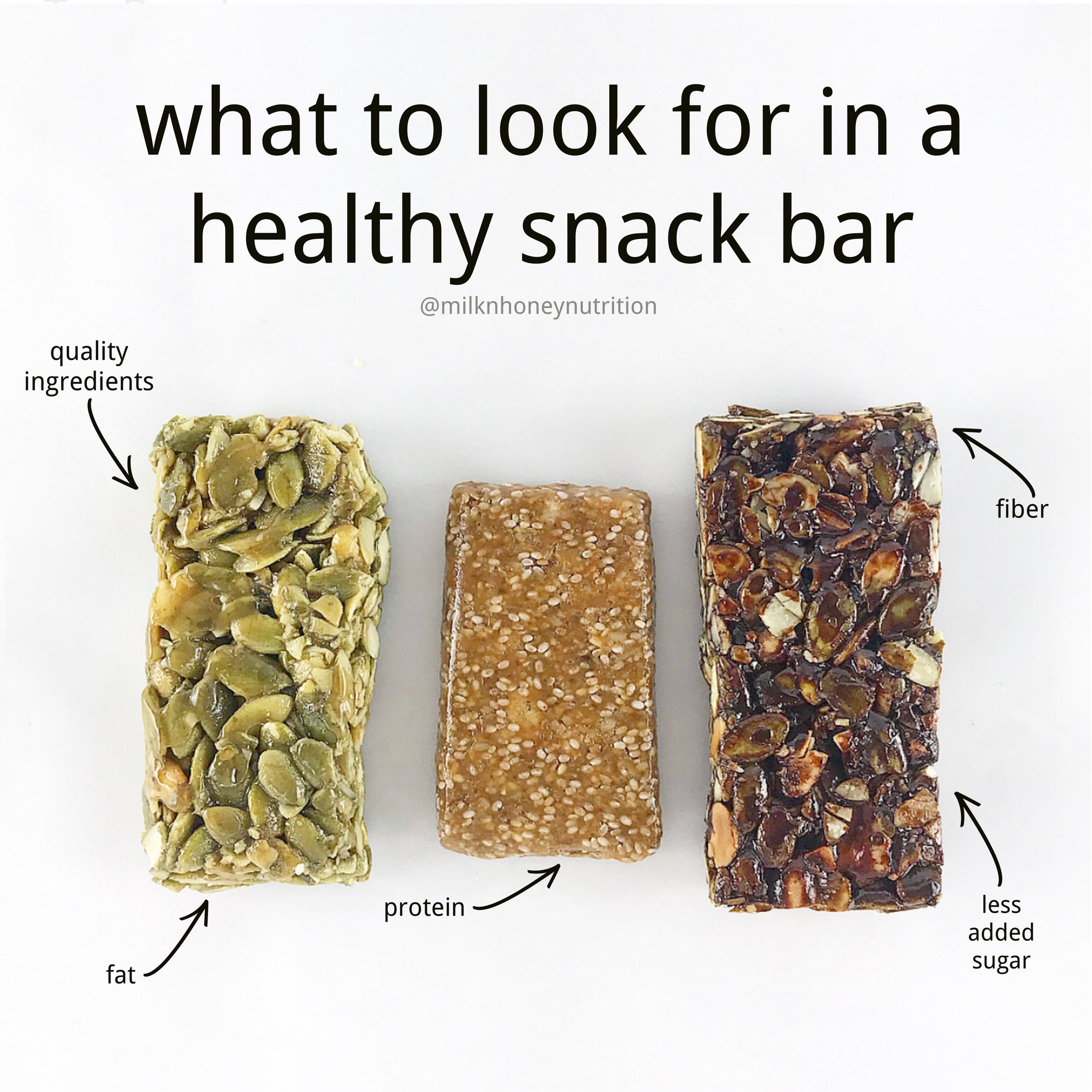
When I’m standing in the snack aisle comparing two bars, I’m usually looking at five things: what I need the bar to do, protein, fiber, added sugar, and the types of ingredients and fats it contains.
I don’t spend ten minutes analyzing every number on the label. These are the pieces that give me the most useful information.
1. Decide What You Need the Snack Bar to Do
This is always my first question.
If I just need something to get me from lunch to dinner, I don’t necessarily need a giant bar with 20g protein. A smaller bar with some protein, fiber, and fat may do the job perfectly well.
If that bar is standing in for a bigger part of breakfast or lunch, I want more substance. I’m going to look for more protein and enough overall nutrition to actually keep me satisfied.
That’s why I don’t give one exact calorie or protein target that every snack bar needs to hit. Context matters! A perfectly reasonable afternoon snack may be pretty underwhelming as breakfast.
2. Look at the Protein
For a snack, I generally like to see at least 4g protein or 4g fiber, and ideally some of both.
Protein can come from nuts, seeds, peanut butter, almond butter, dairy proteins, or concentrated plant proteins such as pea or brown rice protein.
Whey protein is another common ingredient in bars. It tends to upset my stomach, so I personally choose other protein sources when I can. That’s a preference based on how my body responds, not a rule everyone needs to follow. If whey works well for you, there is no reason you need to avoid it.
And don’t let the words “protein bar” do all the thinking for you! I’ve seen plenty of regular snack bars with a useful amount of protein and plenty of protein bars that aren’t necessarily what I’m looking for. Check the actual number.
3. Look for Fiber
Fiber is another number I always glance at.
Oats, whole grains, dried fruit, nuts, and seeds can all contribute fiber naturally. Some bars also contain added fibers, so looking at the Nutrition Facts label gives you a much clearer picture than trying to guess from the ingredient list alone.
There’s good research behind paying attention to fiber too. A 2024 review of dietary fiber and cardiometabolic healthfound that higher fiber intake can support glycemic control and blood lipid levels, with different types of fiber offering different benefits.
When I’m thinking about blood sugar management, I’m rarely looking at carbohydrate by itself. I want to know what else is riding along with it. Fiber, protein, and fat can all influence how satisfying a snack is and how it fits into the rest of the meal or day.
I explain that approach more in my guide to blood sugar balance and choosing the right foods.
4. Compare Added Sugar and Total Sugar
This is one of the label distinctions I wish more people knew about because total sugar and added sugar are not the same thing.
Total sugars include naturally occurring sugars plus any sugars added during processing. So, if a bar contains dried fruit, some of the sugar on the label may simply be coming from the fruit itself.
The FDA’s added sugars guidance explains how added sugars are listed separately from total sugars on the Nutrition Facts label. That makes it much easier to see how much sugar was added during manufacturing.
The current Dietary Guidelines for Americans, 2025–2030 also recommend prioritizing nutrient-dense foods and limiting highly processed foods that contain added sugars and refined carbohydrates.
That said, I’m not tossing a bar back on the shelf just because it contains some added sugar. If a little chocolate makes the bar taste better and I’m actually going to enjoy eating it, that matters too!
I look at added sugar alongside protein, fiber, fat, and total carbohydrate. One number never tells the whole story.
And if your snack search is mostly being driven by a sweet tooth, I have plenty of quick healthy snacks for a sweet tooth that use the same balanced approach.
5. Pay Attention to Fat and the Ingredient List
A healthy snack bar absolutely does not need to be low fat.
I care much more about where the fat is coming from.
Nuts, seeds, peanut butter, almond butter, and other nut butters provide mostly unsaturated fats along with varying amounts of protein and fiber. Those are ingredients I’m generally happy to see in a snack bar.
There’s research supporting those foods too. A systematic review and meta-analysis of nearly 1.9 million participants found that higher nut and seed consumption was associated with a lower risk of cardiovascular disease, although the findings for type 2 diabetes were less conclusive.
I also take a quick look at the ingredient list. I don’t need every ingredient to sound like something I could pull out of my pantry, and I definitely don’t judge a bar by how short the ingredient list is.
What I want to know is what makes up most of the bar.
If oats, nuts, seeds, dried fruit, or nut butter are doing most of the work, I’m getting more useful nutrition from those ingredients than I would from a bar made mostly from refined starches and several different sweeteners.
I also check saturated fat, especially in a bar I plan to eat regularly. The American Heart Association’s saturated fat guidance notes that eating too much saturated fat can raise LDL cholesterol, and higher LDL cholesterol increases the risk of heart disease and stroke.
This is another reason I like looking at the whole label. A single number rarely gives me enough information to decide if a bar works for me.
Choosing a Snack Bar for Blood Sugar Management
When I’m choosing a snack bar for myself, total carbohydrate is another number I always check.
This is where looking only at added sugar can get misleading.
A bar may have very little added sugar and still contain carbohydrate from oats, whole grains, dried fruit, or other ingredients. That isn’t automatically a problem! It just means I need to account for the total carbohydrate rather than assuming “low sugar” means “low carb.”
The amount of carbohydrate that works for you can depend on your blood sugar, activity, medications or insulin, what else you are eating, and what you need from the snack.
For me, the better question is usually: What am I getting along with those carbohydrates?
If the bar also gives me protein, fiber, and fat, I have a much clearer picture of how it fits into my snack or meal.
For specific products I regularly recommend, my list of packaged snacks for blood sugar management is a good place to start.
Healthy Snack Ideas When You Don’t Want a Bar
I love the convenience of snack bars, but sometimes I’d rather eat actual apple slices than something shaped like a rectangle!
The same nutrition principles work with plenty of simple foods you probably already have at home.
Some of my favorite healthy snack ideas include:
- Apple slices with peanut butter or almond butter: The apple provides carbohydrate and fiber, while the nut butter adds fat and protein.
- Greek yogurt with berries: Greek yogurt is an easy protein-rich option, and berries add carbohydrate and fiber.
- Cottage cheese with fruit: Cottage cheese gives you plenty of protein, and you can use whatever fruit happens to be in the fridge.
- Hard-boiled eggs with whole-grain crackers or fruit: I like this one when I want something savory that I can prep ahead.
- Air-popped popcorn with nuts: Popcorn provides whole-grain carbohydrate and fiber, while nuts add fat and protein.
- Trail mix with nuts, seeds, and dried fruit: This is one of my favorite portable options because it’s easy to portion ahead and stash in a bag.
For even more combinations, these low-glycemic snack ideas recommended by a dietitian include both homemade and packaged options.
And snack needs can change depending on the time of day. If you’re specifically looking for something before bed, my guide to bedtime snacks for blood sugar management explains what I look for in an evening snack.
Healthy Snack Bar Takeaways
There is no single nutrition number that determines if a snack bar is a good choice, and I think that’s actually good news! You don’t need a complicated checklist or a mathematically perfect bar.
Start with what you need from the snack, then use the Nutrition Facts label and ingredient list to see what the bar is actually giving you.
As a dietitian, I’d much rather you know how to compare two bars and confidently choose the one that works for you than memorize an arbitrary set of nutrition rules. Once you know what matters on that label, shopping for snack bars gets a whole lot easier!



One Response
I could not agree more. It has been a hassle to pick out the healthiest bars from so many similar looking bars. Thank you for sharing these, definitely going to look at the ingredients more closely.